Devotion
Divine Mercy
Divine Mercy is God's loving response to human weakness. This devotion invites us to trust Christ, receive his mercy, and carry that mercy into the lives of others.
Featured devotion
Divine Mercy
Explore the message of Divine Mercy and the F.I.N.C.H. practices: Feast, Image, Novena, Chaplet, and Hour.
What is Divine Mercy?
The Divine Mercy message and devotion is not just about our devotion to God — it is about His love for us. God's very nature is love — a perfect love shared by the Persons of the Most Holy Trinity (Father, Son, and Holy Spirit). "Divine Mercy" is the form God's love takes when it flows from the Trinity to His creatures. Divine Mercy reveals itself when God, who is Love itself, loves us. God loved us when He created us. He loved us when He redeemed us. And He loves us when He sanctifies us. (These are three of God's greatest acts of mercy.) When God saw His beloved creatures fall into sin and get "broken," He did something about it. What did He do? He made covenants with humanity to heal the breach, ultimately sending His Son. That is why Divine Mercy is a Person, not just an attribute of God. The Divine Mercy takes on human flesh in Jesus Christ. "Jesus Christ is the face of the Father's mercy," explains Pope Francis in the papal document Misericordiae Vultus (The Face of Mercy). So mercy is a particular kind of love. When love encounters suffering, poverty, brokenness, and sin, it mercifully takes action to do something about it. Mercy is love going out to misery; Divine Mercy, among other things, is love poured on sinful humanity to free it of sin and its consequences. As Pope John Paul II explained in the encyclical Dives in Misericordia (Rich in Mercy), mercy is love's second name.
Is Divine Mercy Necessary?
Devotions received through private revelation (like the Five First Saturdays devotion) have always been optional in the Catholic Church (meaning we can still enter Heaven even if we do not fulfill all the requirements of a particular devotion). As such, they are not a part of the deposit of the faith. However, while ignoring approved private revelations may be theologically optional, it is imprudent to not make use of all the means Jesus gives us to attain salvation. That is one reason why Divine Mercy is important. Another reason: It is not just a devotion — it is both a message and a devotion. Pope Benedict XVI said Divine Mercy is the nucleus of the Gospel. So if we reject Divine Mercy, in essence, we reject the Gospel! The message of Divine Mercy is that God loves us, all of us, no matter how great our sins. He wants us to recognize that His mercy is greater than our sins so that we will call upon Him with trust, receive His mercy, and let it flow through us to others. God wants us to turn to Him with trust and repentance while it is still a time of mercy, before He comes as the Just Judge. The way to exercise this message of mercy is as easy to remember as A-B-C: Ask for God's mercy; Be merciful to others; and Completely trust in God's mercy. (Please see our pamphlet "The Message of Divine Mercy," Product Code DMMR.) By exercising mercy, we allow God's mercy to pass through us to the world. God's mercy has been present from the beginning of salvation history. But, over time, mankind has forgotten this mystery and needed to be reminded of it. Therefore, Jesus gave St. Maria Faustina Kowalska (1905-1938) five new channels of grace to emphasize this message, known as the devotion to the Divine Mercy (which is the focus of this pamphlet). Jesus said: "If they will not adore My mercy, they will perish for all eternity" (Diary, 965). So it is in these new elements of devotion that Jesus gave to the Church, through St. Faustina, the means of fulfilling the need to adore Him as Divine Mercy Incarnate. Those five new elements are: the Feast of Divine Mercy, the Image of Divine Mercy, the Novena of Chaplets, the Chaplet of Divine Mercy, and the Hour of Mercy (3 p.m.). Just remember the acronym F.I.N.C.H. Through this powerful new devotion, Jesus simply wanted to renew in the world trust in His mercy.
So, while the devotion to the Divine Mercy (as given to us through private revelation) is optional in some ways, the message of Divine Mercy is not! That message comes to us through God's Public Revelation in the Word of God through Scripture and Tradition. But then why is the optional devotion to the Divine Mercy so important today? Because the devotion to the Divine Mercy (these five channels of grace) brings us closer to God and helps us to a deeper living of the message of Divine Mercy!
Saint Faustina and the Devotion to the Divine Mercy
Authentic private revelation is never in opposition to what has already been revealed in Public Revelation. While it doesn't teach anything new about faith and morals, it further explains and applies the unchanging faith and morals given through God's Public Revelation in new ways particularly suited to the needs of each age of history, especially through new devotions. In this way, approved private revelation has great value. In our present age, the Lord has made it clear through the Polish mystic St. Faustina that before He returns as a Just Judge. He stands before us as the Merciful Savior, as Divine Mercy itself. As a member of the Congregation of Sisters of Our Lady of Mercy, St. Faustina received extraordinary revelations from our Lord Jesus, which she compiled in notebooks. These notebooks are known today as the Diary of Saint Maria Faustina Kowalska, a modern spiritual classic. In it, the Lord told St. Faustina: "You will prepare the world for My final coming" (Diary, 429). And she did this through emphasizing in a new way the timeless message of God's mercy. The devotion draws its power from, and calls us back to, the great Sacraments of mercy, especially the Holy Eucharist, Baptism, and Confession. As mentioned above, we can best remember the devotion to the Divine Mercy through the acronym F.I.N.C.H.
F: Feast
The Feast of the Divine Mercy, also known as Divine Mercy Sunday, is the Second Sunday of Easter (the Sunday immediately following Easter Sunday). You may know that Easter is the most important feast day of the year, but you may not know that we actually celebrate it over eight full days, which is why we call it the "Octave of Easter." Moreover, the second Sunday of Easter is the last day of the octave, the eighth day, which is the greatest of all, the climax of the whole feast. In a sense, Divine Mercy Sunday is the most important day of the most important feast! Fittingly, Jesus promised to give great graces on Divine Mercy Sunday. Specifically, He told St. Faustina:
On that day [Divine Mercy Sunday], the very depths of My tender mercy are opened. I pour out a whole ocean of graces upon those souls who approach the fount of My mercy. ... On that day, all the divine floodgates through which graces flow are opened (Diary, 699).
Regarding the graces of Divine Mercy Sunday, Jesus told St. Faustina, "The soul that will go to Confession and receive Holy Communion shall obtain complete forgiveness of sins and punishment" (Diary, 699).
This is an extraordinary promise! This is because when we normally go to Confession, the temporal punishment due to sin (i.e., hell) is removed, but the temporal punishment due to sin (i.e., Purgatory) may still remain (see JS 99:8). Unless we have perfect contrition, or pray fast, and/or give alms with perfect purity of intention, temporal punishment as a consequence of our sins most likely remains. But all sins and punishment are removed by the grace of Divine Mercy Sunday when we fulfill the conditions of a valid Confession and worthily receive Holy Communion, as long as we have some rectification of the will (meaning that we are sorry and will try to amend our life). In fact, the grace of Divine Mercy Sunday has been compared to the grace of Baptism. It forgives all sins and provides for the removal of all punishment due to sin (even for sins forgiven to be confessed) and is fully effective even if our contrition is less than perfect. What is required is receiving Holy Communion worthily with trust in Jesus' promise.
Unfortunately, a lot of people confuse the great grace of Divine Mercy Sunday with a plenary indulgence. It's not exactly the same thing, however. With a plenary indulgence, not only must we perform the indulgenced act (like reading 30 minutes of Scripture or walking the Stations of the Cross) but we must fulfill four additional conditions: 1) we must receive Holy Communion on the same day that we perform the indulgenced act; 2) we must go to sacramental Confession "about 20 days" before or after doing the act, even if we are in the state of grace; 3) we must pray for the intentions of the Holy Father (usually an Our Father, Hail Mary, and Glory Be); and 4) we can have no attachment to sin — even venial sin. Wow! That isn't easy.
To receive the grace of Divine Mercy Sunday, you simply need to go to Confession before or on the day of the feast — sometime during Lent suffices; be in the state of grace on Divine Mercy Sunday itself (no mortal sin); and receive Holy Communion with the intention of obtaining the promised grace. Another beautiful element of Divine Mercy Sunday is that the Church also gives us the opportunity to receive a plenary indulgence attached to an act of worship of the Divine Mercy or participation in a Divine Mercy service on the same day (under the normal conditions) that we can offer for ourselves or for a Holy Soul in Purgatory.
I: Image
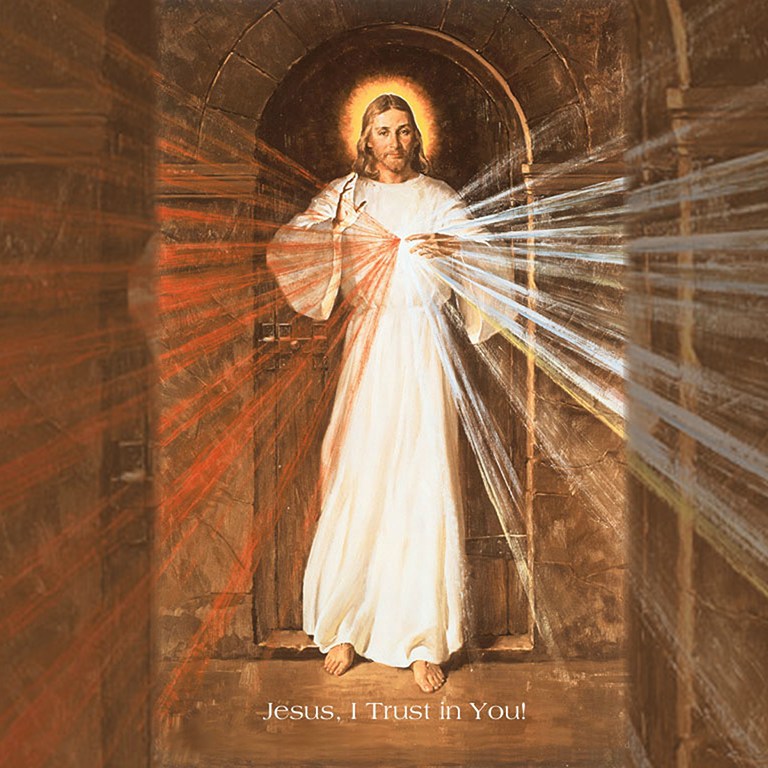
When Jesus appeared to St. Faustina, He told her to have an Image painted according to the pattern that she saw before her. Now this Image is known around the world, fulfilling our Lord's desire. He asked for the Image to be solemnly venerated, especially on Divine Mercy Sunday (Diary, 341). Always keep in mind that we don't worship the canvas or the paint or the Image itself — we worship what it represents: Jesus, the Divine Mercy. Jesus said, "I promise that the soul that will venerate this image will not perish. I also promise victory over [its] enemies already here on earth, especially at the hour of death. I myself will defend it as My own glory" (Diary, 48). He continued, "I am offering people a vessel with which they are to keep coming for graces ... That vessel is this image with the signature, 'Jesus, I trust in You.' ... By means of this image, I shall grant many graces to souls" (Diary, 327, 742).
Especially important is Jesus' Sacred Heart. From it emanate the Blood (red ray) and water (pale ray). These two rays defeat Satan's only two weapons: sin and death. Sin is wiped away by the cleansing waters of Baptism and the healing words of Confession. Death is wiped away by life — and life, to the Jews, was in the blood. Blood provides us life, so we receive life in Holy Communion. These rays represent what Christ asks us to do on the Feast of Divine Mercy Sunday: Go to Confession and receive Holy Communion.
The left foot stepping forward is symbolic of Christ coming to us, searching for the lost sheep, and His return at the end of time. We have received countless testimonies from many of those "little sheep" of healing, protection from storms, and conversions through this Image.
N: Novena
A novena is usually nine consecutive days of prayer. Jesus told St. Faustina that the Chaplet of Divine Mercy (see below) is also to be offered as a novena, and gave to her specifically a particular set of intentions to offer along with that Novena. Each day, He asked that a different group of people be entrusted to Him (for example, "all sinners" on day one and "all priests and religious" on day two). This Novena of Chaplets can be prayed at any time with those special intentions (often called the Divine Mercy Novena), but the nine days before Divine Mercy Sunday are a special time to pray it. The starting date for the Divine Mercy Novena is Good Friday. It ends on the Saturday after Easter Sunday, the day before Divine Mercy Sunday. (Novenas typically end the day before the feast.) While you don't have to pray this Novena to obtain the grace of Divine Mercy Sunday, it is a good way to prepare. Jesus promised, "By this novena [of Chaplets], I will grant every possible grace to souls" (Diary, 796). We can also pray nine consecutive days of Chaplets at any time for any intention dear to our heart.
C: Chaplet
The Divine Mercy Chaplet is prayed on ordinary Rosary beads. The Chaplet is powerful because it draws its strength from the Mass. In other words, the Chaplet of Divine Mercy is a kind of extension of the prayer of the Mass. Vatican II tells us that, by virtue of our Baptism, we participate in the three offices of Christ: Priest, Prophet, and King. What does a priest do? A priest offers sacrifice. So when you say, "Eternal Father, I offer you the Body and Blood, Soul and Divinity, of Your dearly beloved Son, Our Lord, Jesus Christ ..." you are exercising your baptismal priesthood! This is why we can say this prayer and not deem ourselves unworthy of offering Christ to the Father. (Please see our pamphlet "The Divine Mercy Novena and Chaplet," Product Code LFMCN, on how to pray the Chaplet.)
Jesus made several comforting promises to those who pray the Chaplet:
Say unceasingly the chaplet that I have taught you. Whoever will recite it will receive great mercy at the hour of death. ... Even if there were a sinner most hardened, if he were to recite this chaplet only once, he would receive grace from My infinite mercy (Diary, 687; see also 1541).
The souls that say this chaplet will be embraced by My mercy during their lifetime and especially at the hour of their death (Diary, 754).
H: Hour
Because Jesus died on the Cross for us at 3 p.m., every day between 3 and 4 in the afternoon is known as the Hour of Great Mercy. During this hour, Jesus asked St. Faustina to pray the Stations of the Cross, provided her duties permitted it. But He went on to say:
As often as you hear the clock strike the third hour [the hour of Christ's death], immerse yourself completely in My mercy, adoring and glorifying its invoke its omnipotence for the whole world, and particularly for poor sinners ... In this hour you can obtain everything for yourself and for others for the asking (Diary, 1572).
What Jesus wants above all through this devotion is that we have mercy on Him! In other words, He wants us to recall His sacrifice of love. He wants us to think about what He did for us on the Cross. Jesus also promised, "This is the hour of great mercy for the whole world. ... I will refuse nothing to the soul that makes a request of Me in virtue of My Passion" (1320). Thus, we can look at this hour as a kind of mini Divine Mercy Sunday that arrives every day. So it's a great time to pray for our loved ones, especially for the conversion of unrepentant sinners, and to recite the Chaplet of Divine Mercy.
Summary
These are the basics of the Divine Mercy devotion — important ways to more deeply live the message of Divine Mercy.
Please continue your journey by reading our pamphlet "The Message of Divine Mercy" (Product Code DMMR), which explains the obligatory "ABCs" of the message of Divine Mercy. As Fr. Seraphim Michalenko, MIC, summarized, "The message is nothing new, just a reminder of what the Church has always taught: that God is merciful and forgiving and that we, too, must show mercy and forgiveness. But, in the Divine Mercy devotion, the message takes on a powerful new focus, calling people to a deeper understanding that God's love is unlimited and available to everyone — especially the greatest sinners."
In the words of Pope Benedict XVI, "Divine Mercy is not a secondary devotion, but an integral dimension of Christian faith and prayer."
Jesus, I trust in You.